
Window Glass Performance Values 3 - Solar Shading Performance Values
Solar Heat Gain Coefficient (η-Value)
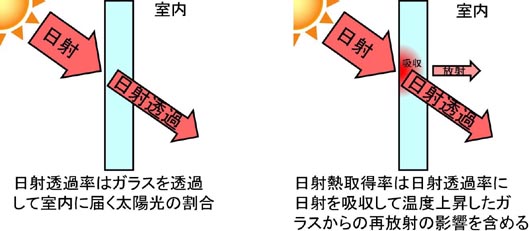
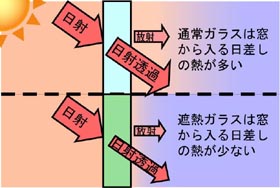
A value defined by JIS R3106 representing the proportion of heat from sunlight hitting glass that is transmitted indoors. Smaller solar heat gain coefficient means higher effect of blocking heat from sunlight, i.e., high solar shading.
Shading Coefficient (SC-Value)
A relative value of solar heat gain coefficient (shading coefficient = solar heat gain coefficient / 0.88) when solar heat gain coefficient of 3mm thick transparent float glass (0.88) is used as reference.
Therefore, solar heat gain coefficient and shading coefficient are performance values showing the same function with different references.
Solar heat gain coefficient (shading coefficient) is a performance value similar to solar transmittance in optical performance , but while solar transmittance only represents light transmittance, solar heat gain coefficient also considers impact of heat absorbed by glass on indoors.
Therefore, when comparing heat-absorbing glass with high solar absorption rate and heat-reflecting glass with high solar reflection rate, even if solar transmittance is the same, solar heat gain coefficient is lower for heat-reflecting glass. Also, the effect of LowE glass used in high thermal insulation insulating glass units, "suppression of heat movement by low emissivity," is about far-infrared range, so transparent LowE glass does not much affect solar shading performance (in cases of glass with high solar absorption rate, movement of heat absorbed by glass is suppressed, so it also affects solar shading performance). Solar shading LowE glass becomes high in reflection and absorption effects in near-infrared to visible light ranges in addition to the above far-infrared range effects.
 |
|

When using high solar shading glass in rooms with good sunlight, summer temperature rise from sunlight can be reduced, but winter benefits from sunlight also become difficult to obtain. Also, since solar shading performance is performance to block sunlight, using high solar shading glass in windows with little sunlight has no particular effect except for decorative cases or special situations. Also, from the perspective of reducing air conditioning load, thermal insulation is often more effective than solar shading, but in situations where sunlight hits the body, solar shading effects have large impact perceptually.
| ※1 | 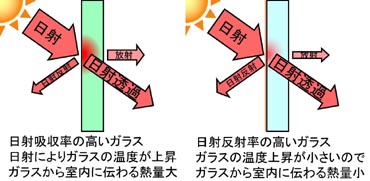 |
| ※2 | In houses with high thermal insulation, rooms with good sunlight may require cooling even in winter due to room temperature rise. Since various factors such as your region, sunlight, overall room thermal insulation, volume, window orientation, and size affect this, please consider after consulting with house manufacturers and design offices. |
| ※ | Explanations on this page are simplified for easy understanding and do not necessarily explain accurate meanings of terms. |