
Window Glass Performance Values 1 - Optical Performance Values
Window glass requires performance such as light transmission, thermal insulation, and solar shading according to installation environment. Among glass characteristic values for judging these, this time we explain optical performance values.
Visible Light Transmittance (Reflectance)
The proportion of light that human eyes can detect brightness (wavelength: 380~780nm) among light hitting glass that transmits or reflects through glass. Higher transmittance values make indoor spaces brighter during daytime. Visible light transmittance of thin glass of 5mm or less is about 90%, but the remainder is about 8% visible light reflectance and about 2% visible light absorption, and since reflection effects occupy most, it does not change much with slight thickness differences.
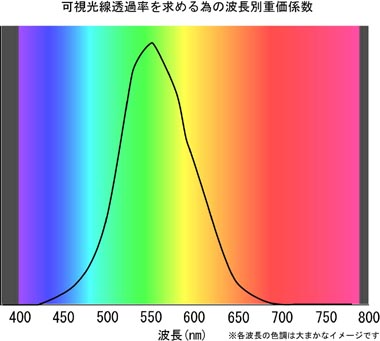
Visible light transmittance and visible light reflectance are values affecting appearance, but do glass with the same values look exactly the same? This is not the case. These values are calculated according to JIS R3106 by multiplying transmittance (reflectance) of each wavelength by coefficients according to luminosity. If thinking about blue glass (only 430~480nm wavelength 100% transmittance), green glass (only 530nm~580nm wavelength 100% transmittance), red glass (only 630nm~680nm wavelength 100% transmittance), and colorless glass (380nm~780nm wavelength 50% transmittance), visible light transmittance of each glass becomes blue: 3.9%, green: 54.0%, red: 5.1%, colorless: 50%, showing that green (530~580nm wavelength) has very large impact. However, from visible light transmittance values alone, it cannot be judged whether light of each wavelength transmits averagely (no color) or has specific color tones.
Then, if comparing transmittance of each wavelength, do glass with matching values look exactly the same? This is also not necessarily the case. Comparing patterned glass and frosted glass with standard transparent glass, even when compared by wavelength-specific values, they almost match, but appearance is completely different. Patterned glass and frosted glass change light direction due to surface irregularities, resulting in different appearance from transparent glass.
In this way, visible light transmittance and visible light reflectance are indicators of brightness that can be brought indoors, but glass appearance is not determined by these values alone.

Solar Transmittance (Reflectance)
The ratio of solar radiation (wavelength: 300~2500nm) incident perpendicular to glass surface that transmits (reflects) through glass. Higher transmittance values increase the scorching feeling when exposed to sunlight through glass.
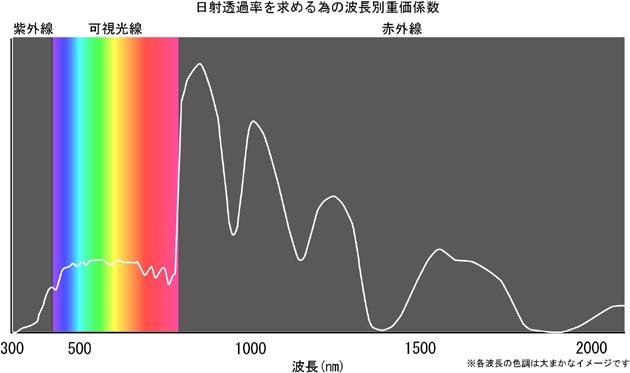
This value is calculated according to JIS R3106 by multiplying measurement data up to ultraviolet, visible light, and near-infrared with coefficients according to solar spectrum. When graphing coefficient values, coefficients are large around wavelengths 850nm and 1000nm, and visible light impact appears small. However, in actual calculations, visible light range handles 5 times the data amount of infrared range (380~780nm range finds weighted average in 10nm increments, 800nm~2100nm in 50nm increments), so unlike graph appearance, visible light range also has large impact. If visible light (380nm~780nm) transmittance were 100%, that alone would make solar transmittance value 51.6%.
Therefore, there are limits to achieving both solar shading performance (low solar transmittance) and light transmission performance (high visible light transmittance), and when seeking solar shading performance beyond that, it is necessary to consider balance with brightness and color tones.