
Window Condensation and Curtain Impact
Have you ever felt that condensation didn't decrease much even though you purchased high thermal insulation insulating glass units? Actually, when curtains are closed, glass surfaces become prone to condensation.
Condensation occurs when warm, moisture-containing indoor air is cooled by cold window glass surfaces (for details, refer to " About Condensation"). Here, when using insulating glass units with high thermal insulation for windows, indoor-side glass is less affected by outside air due to thermal insulation air layer effects, and indoor-side glass surface temperature becomes close to indoor temperature, making condensation less likely to occur.
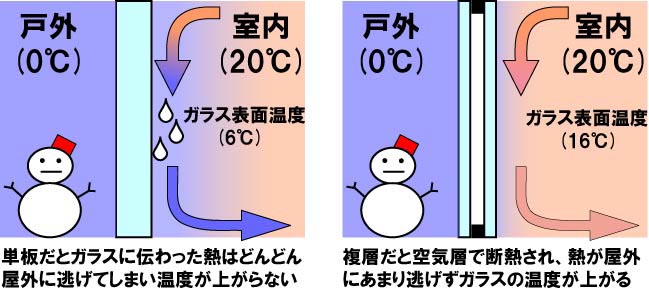
However, no matter how high the thermal insulation of insulating glass units, since glass itself has no heating function ( Twin Thermoglass is excluded), glass surface temperature must be warmed by indoor air. If curtains are closed, indoor air has difficulty reaching glass surfaces, so glass surface temperature does not rise much and condensation becomes likely to occur.
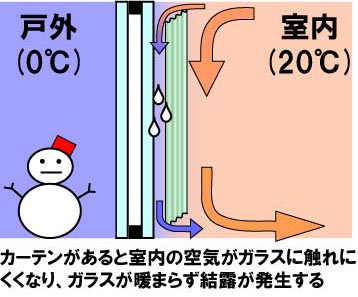
As an extreme example, thinking about the case of closing curtains that do not transmit heat at all, indoor-side glass surface temperature can only become the same as outdoor air temperature regardless of glass thermal insulation performance, so if indoor air flows in here, condensation occurs.
Of course, such curtains do not exist in reality, so indoor-side glass surface temperature rises according to glass thermal insulation performance, but it can be seen that the higher curtain thermal insulation and lower glass thermal insulation, the larger the difference between room temperature and glass surface temperature, making condensation more likely to occur. If air between curtains and glass could be kept in a dry state like internal air layers of insulating glass units, condensation would not occur even in this state, but there are no curtains that can completely seal to prevent moisture passage and dry air.