
About Condensation
Principle of Condensation Occurrence
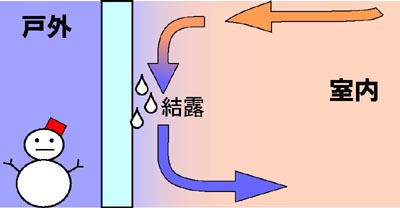
The unpleasant condensation that occurs on window glass in winter happens when warm, moisture-containing indoor air is rapidly cooled by cold window glass, causing local humidity to exceed 100%. Therefore, by improving the thermal insulation of window glass and making the indoor-side glass less affected by outdoor temperature, condensation can be suppressed.
The humidity commonly used is accurately called relative humidity and is a value closely related to air temperature. Relative humidity is obtained by dividing the amount of water vapor contained in the atmosphere by the saturated water vapor amount corresponding to that air temperature. Saturated water vapor amount is the upper limit of the amount of moisture (water vapor) that can be contained in the atmosphere, and air can contain more moisture as the temperature increases.
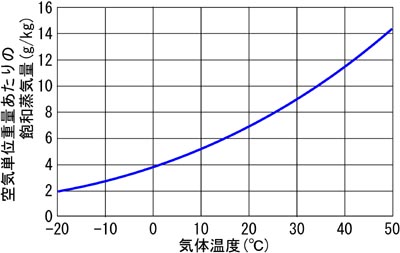
Specifically, from the graph above, if the air temperature is 30°C, 1kg of dry air can contain 9g of water vapor, but if the air temperature becomes 10°C, 5g is the limit. Based on this, if there is 4g/kg of water vapor in the air, it is expressed as relative humidity 44% at 30°C air temperature, and relative humidity 80% at 10°C air temperature. Under these conditions, relative humidity becomes 100% at 0°C air temperature, and when the temperature drops below that, water vapor in the atmosphere exceeding the saturated water vapor amount appears as condensation. Therefore, condensation on glass can be prevented by drying the indoor air or raising the temperature of the indoor-side glass.
| Indoor-Side Glass Surface Temperature | Condensation Occurrence Relative Humidity | |
|---|---|---|
| FL3 | 8°C | 33% |
| FL3+A12+FL3 | 17°C | 60% |
| FL3+A12+LowE3 | 19°C | 70% |