
Glass (Windows) and Soundproofing 2 - Soundproofing Characteristics of Each Glass
Glass used for windows is roughly divided into three types: single-pane glass, laminated glass, and insulating glass units. We explain differences in these glass types from a soundproofing perspective.
・ Sash Impact
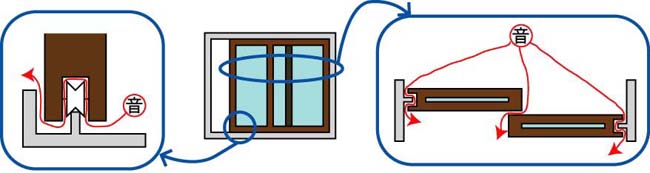
When considering window soundproofing, glass performance is of course important, but sash soundproofing performance cannot be ignored. Just as any high-performance soundproofing window has no effect when open, with sash with low airtightness, even if glass is replaced, no effect may be obtained at all. The most common sliding windows easily develop gaps between sashes and rails or between sashes due to structure.
・ Single-Pane Glass
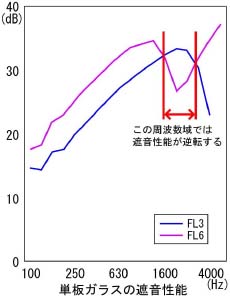
Soundproofing performance of single-pane glass generally follows mass law, but is affected by coincidence effect, so soundproofing performance significantly decreases near coincidence critical frequency. Therefore, while basically thicker glass has higher soundproofing performance, if sound to be blocked contains sound near coincidence critical frequency, changing to thick glass may not provide expected effects (for example, changing 3mm glass to 6mm increases soundproofing performance overall by about 5dB, but decreases soundproofing performance by about 5dB at 1600Hz~3200Hz). Also, differences in glass types such as wired glass, patterned glass, and tempered glass with almost unchanged mass hardly affect soundproofing performance.
・ Safer (Laminated Glass)
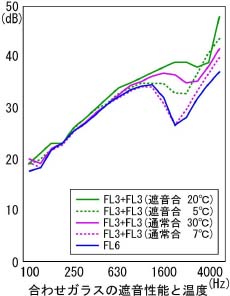
Since laminated glass has a structure bonding two panes of glass with resin interlayer, it basically has soundproofing performance similar to single-pane glass of the same thickness. However, in laminated glass, resin interlayer between glass panes suppresses coincidence effect, so higher soundproofing performance than single-pane glass can be expected for sound near coincidence lowest frequency. However, this effect gradually weakens with temperature decrease, and especially in low-temperature environments below 10°C, it is affected by coincidence effect almost the same as single-pane glass.
・ Sound Safer (Soundproofing Laminated Glass)
Soundproofing laminated glass is laminated glass using dedicated interlayer with higher coincidence effect suppression performance than standard laminated glass interlayer, and can almost prevent soundproofing performance decrease even near coincidence lowest frequency. Also, while standard laminated glass loses interlayer soundproofing performance (coincidence effect suppression effect) almost completely when temperature decreases, soundproofing laminated glass can expect effects even at 5°C.
Click below to experience soundproofing effects with Sound Safer. (Volume caution)



・ Twin Glass (Insulating Glass Units)
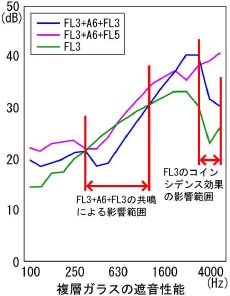
Since insulating glass units are composed of two panes of glass with air layer between, high soundproofing effects are often expected, but actually this is not the case. On the contrary, depending on frequency, they may be inferior to soundproofing performance of a single pane of constituent glass. This is mainly because in low-frequency ranges, sealed air inside insulating glass units and two panes of glass resonate like a drum, causing significant soundproofing performance decrease. Also, glass panes composing insulating glass units are each affected by coincidence effect, so in compositions using glass of the same thickness on both sides of insulating glass units, soundproofing performance significantly decreases near coincidence lowest frequency. Therefore, standard insulating glass units composed of glass of the same thickness have soundproofing performance decrease in two frequency ranges compared to mass law: low-frequency resonance frequency range and coincidence lowest frequency. If insulating glass units are composed in combinations like FL3 and FL5 where one glass has high soundproofing performance even near the other's coincidence lowest frequency, coincidence effect impact can be considerably reduced. However, even then, resonance occurs in low-frequency ranges and soundproofing performance decreases.
Comparing glass soundproofing performance by structural differences in this way, roughly
Sound Safer (Soundproofing Laminated) > Safer (Laminated) > Single-Pane Glass > Twin Glass (Insulating) ※1
in this order. However, even for window noise countermeasures alone, it is not necessarily the case that simply making glass thicker or increasing the number of panes is good. If considering serious noise countermeasures, we recommend consulting with specialists.※2