Differences in Glass Breakage by Processing
Glass Breakage Patterns
Glass is used to bring natural light into buildings utilizing its transparency, or to observe the inside of sealed containers. It is an inexpensive and convenient material with excellent weather resistance, maintainability, and chemical resistance, but its characteristic of "breaking when subjected to strong force" can lead to unexpected accidents. While there is currently no processing method to create unbreakable glass, breakage patterns vary depending on processing and glass type, so we will explain these differences.
Breakage of Standard Glass
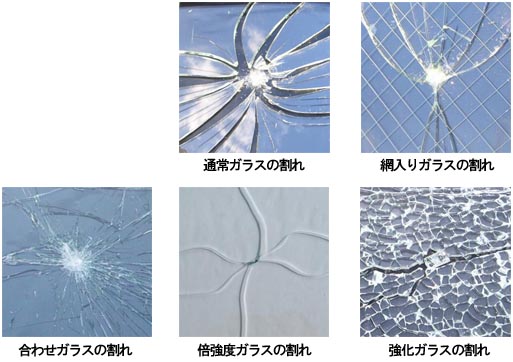
Cracks spread around the point where force is applied, producing large fragments with sharp edges. When film application or lamination processing is performed, the large fragments ensure fragment adhesion, effectively preventing fragment fall. Standard glass, high-transparency glass, heat-absorbing glass, heat-reflecting glass, etc. fall into this category.
Breakage of Wired Glass
Wired glass has a metal mesh embedded inside the glass, and while it breaks under weaker force than glass of the same thickness, it has the effect of preventing fragments from coming loose even when broken. Since it is less likely to create large openings even when the glass breaks, it is used as fire-resistant glass for fire spread prevention.
Breakage of Laminated Glass
Laminated glass bonds two panes of glass with a strong resin film, and even when the glass breaks, fragments do not fall due to the film's adhesion. While stronger than wired glass, the resin film cannot withstand the high heat of fire, so it cannot be used as fire-resistant glass. Due to the hardness of glass and flexibility of resin, it is less likely to create openings, making it suitable for security.
Breakage of Tempered Glass
Tempered glass is glass strengthened by heat treatment to introduce compressive stress on the surface and tensile stress inside. The compressive stress on the surface suppresses the occurrence and spread of small cracks that cause breakage, making it high-strength, but if a crack reaches the tensile stress layer inside, the entire glass shatters into fine granular pieces regardless of crack position or size.
Breakage of Heat-Strengthened Glass
Heat-strengthened glass is glass processed by heat treatment to resist breakage, similar to tempered glass. By keeping the residual stress inside lower than tempered glass, even when it breaks, it does not shatter into granular pieces but forms large fragments similar to standard glass. While stronger than standard glass, it is inferior to tempered glass due to the suppressed surface compressive stress. It is used in high-rise buildings where strength is needed and fragment fall must be prevented, combined with film application or lamination processing.