
About Magic Mirror (Half Mirror) and Lami Trick
Magic mirror appears to be just an ordinary mirror at first glance, but when viewed from the opposite side, a transparent image can be seen like glass - a mysterious mirror. This phenomenon is fundamentally the same as Lami Trick and lace curtains, utilizing the brightness difference between inside and outside the room.
Principle
This phenomenon occurs due to the balance of transmittance and reflectance of the magic mirror and the brightness difference between the indoor and outdoor sides separated by the magic mirror. Let's roughly consider the case where bright outdoors (brightness 100) and indoors (brightness 10) are separated by an ideal magic mirror with 50% transmittance and 50% reflectance. First, when viewing the magic mirror from the outdoor side, a reflected image of outdoors with brightness 50 and a transmitted image of indoors with brightness 5 would be visible. However, just as whispers cannot be heard in noisy places, the dark transmitted image cannot be seen within the bright reflected image, so it appears like an ordinary mirror. Next, when viewing the magic mirror from indoors, a transmitted image of outdoors with brightness 50 and a reflected image of indoors with brightness 5 would be visible, so only the bright transmitted image is seen. On the other hand, when night comes, the brightness inside and outside reverses, so the appearance also reverses.
○ During Daytime
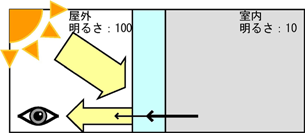
Outdoor observer receives reflected image with brightness 50 and indoor transmitted image with brightness 5, but due to brightness difference, only the reflected image can be recognized.
→ Appears like a mirror

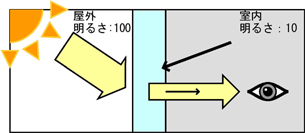
Indoor observer receives transmitted image with brightness 50 and indoor reflected image with brightness 5, but due to brightness difference, only the outdoor transmitted image can be recognized.
→ Appears like glass
○ During Nighttime
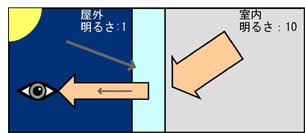
Outdoor observer receives transmitted image with brightness 5 and outdoor reflected image with brightness 0.5, but due to brightness difference, only the indoor transmitted image can be recognized.
→ Appears like glass
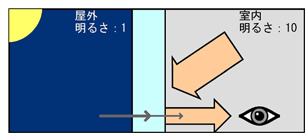
Indoor observer receives indoor reflected image with brightness 5 and outdoor transmitted image with brightness 0.5, but due to brightness difference, only the indoor reflected image can be recognized.
→ Appears like a mirror
Lami Trick and lace curtains adjust the balance of transmission and (diffuse) reflection with small holes to create a similar phenomenon. In other words, for magic mirrors and Lami Trick to be effective, there must be a sufficient brightness difference between inside and outside, and it is important to understand that it is not "glass that allows seeing from inside to outside but not from outside to inside," but rather "glass that prevents (or makes difficult) seeing from the bright side to the dark side."