
Basics of Insulating Glass Units
What is the Thermal Insulation Performance of Insulating Glass Units
There are three phenomena in heat transfer: conduction, convection, and radiation. Thermal insulation materials, including insulating glass units, are those with high ability to suppress these. Let's look at these phenomena in detail:
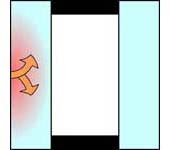
Heat Conduction
Conduction is mainly how heat transfers in solids, a phenomenon where heat diffuses through contacting objects. Generally, thermal conductivity decreases in the order of solid > liquid > gas, and whether for insulating glass units or clothing, thermal insulation generally uses gas (air) to lower overall thermal conductivity.

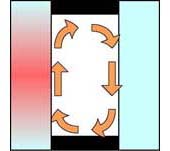
Convection
Convection is how heat transfers in fluids such as liquids and gases, a phenomenon where heat is transferred to another location by movement of heated fluid portions within. The basic principle of thermal insulation performance of insulating glass units is to block air with glass and prevent convection of air between outdoors - inside insulating glass unit - indoors.
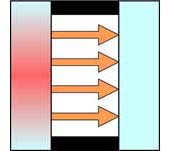
Radiation
Radiation is heat transfer by electromagnetic waves, where heat is transferred by the target absorbing electromagnetic waves generated from heated objects, so heat can transfer even in a vacuum. The warmth felt from sunlight is this phenomenon. In the case of standard insulating glass units, air has no shielding effect against electromagnetic waves, and while glass does not directly transmit, it becomes absorption → temperature rise → radiation, so there is no effect of preventing radiant heat.
In this way, standard insulating glass units obtain thermal insulation effects by sealing air with two panes of glass and using it as transparent thermal insulation material to suppress heat conduction and convection. Like other thermal insulation materials, thermal insulation effect increases as the air layer thickness increases, but in thermal insulation materials consisting of a single air layer, when the thickness exceeds a certain value (about 15mm), convection begins to occur within the air layer, and thermal insulation performance no longer improves. In such cases, it is possible to obtain even higher thermal insulation performance by dividing the air layer with barriers such as glass and suppressing convection.