
Window Orientation and Suitable Glass
Sunlight that feels pleasant in cold seasons becomes painful in summer heat. Glass that reduces such harsh sunlight is solar shading glass. Solar shading glass, when installed on windows receiving sunlight, softens sunlight and reduces heat near windows . Sunlight entering indoors through windows changes according to positional relationship between windows and sun, so we consider effectiveness of solar shading glass from how sunlight hits according to window orientation, season, and time.
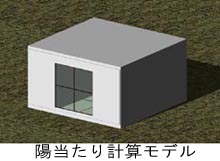
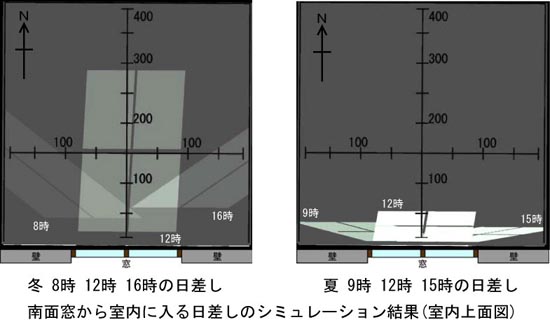
Generally, when thinking of "windows with good sunlight," south-facing probably comes to mind first. So, assuming a building with only windows of 1700mm vertical × 1700mm horizontal on the south side as shown on the right, we consider shadows formed on indoor floors when simulating sun movement near Tokyo.
In winter (January 1) simulation, sunlight begins entering around 8~9 AM, and light reaches about 3m from windows at 12 PM, while in summer (August 1) simulation, even at 12 PM it only reaches about 50cm from windows.

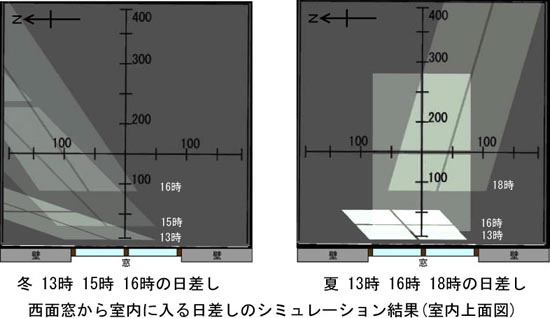
Similarly, simulating when windows are on the west side, sunlight hits from around 1 PM until sunset in both summer and winter, but western sun reaches quite deep into rooms in both summer and winter.
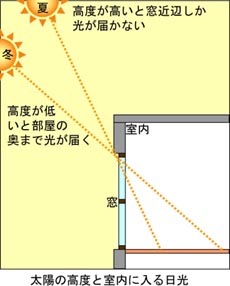
Basically, south windows receive light around noon when sun altitude is highest during the day, but this sun altitude changes with season. In winter, meridian altitude is low and sun draws a low orbit, so light enters indoors even during daytime, but in summer, sun draws a high orbit, so only areas near windows receive sunlight.
In contrast, west windows receive sunlight from afternoon to evening, and evening sun is at low angles regardless of season, so sunlight reaches deep into rooms regardless of season.
Therefore, when thinking about avoiding harsh summer sunlight, south side can be avoided by moving slightly away from windows, but avoiding sunlight entering from west windows is difficult. Also, east side has almost the same sunlight as west side, but since temperature is lower than evening, it is somewhat more bearable.
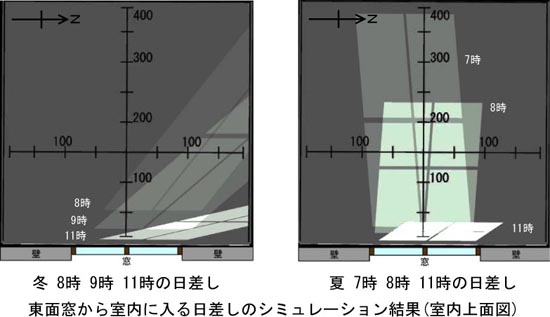
From these points, ranking orientations needing solar shading glass becomes West > East > South. While solar shading glass has several types, generally those with higher solar shading effects tend to weaken winter sunlight as well, of course, and brightness also tends to become darker. Rather than simply matching glass, we recommend selecting glass according to windows considering sunlight, regional weather conditions, room use, and thermal insulation including the entire house . North windows do not receive direct sunlight, so normally there is no need to consider solar shading . (Used when matching building exterior or window color tones)
Types of Solar Shading Glass
Solar shading glass handled by our company includes Heat-Absorbing Glass, Heat-Reflecting Glass, laminated glass structure Cool Safer, insulating glass units using solar shading LowE LE Twin Glass (Solar Shading Type), and Heat Mirror Glass (Solar Shading Type) using solar shading heat mirror film. Please select according to use.