
Window Glass Performance Values 2 - Thermal Insulation Performance Values
Thermal Transmittance (U-Value)
A value expressed in watts representing heat quantity moving per 1㎡ when temperature difference between inside and outside is 1°C. It represents heat quantity per time transmitted through glass, and smaller values mean heat is difficult to transmit = high thermal insulation.
Heat quantity transmitted through glass from high-temperature side air to low-temperature side air is calculated. For single-pane glass, referring to JIS R3107
1. Heat transfer from air to glass
2. Heat conduction within glass
3. Heat transfer from glass to air
can be obtained by performing heat transfer calculations for these 3 processes, but in insulating glass units, calculation processes become complex because heat radiation from glass and convection of internal air layers must be considered in thermal insulation air layer calculations.
| Glass | Thermal Transmittance |
|---|---|
| FL3 (3mm glass) | 6.0 W/㎡·K |
| FL12 (12mm glass) | 5.7 W/㎡·K |
| 6mm+6mm Laminated Glass | 5.5 W/㎡·K |
| FL3+Air Layer 6mm+FL3 Insulating Glass Unit | 3.4 W/㎡·K |
| FL3+Insulating Gas 16mm+LowE3 | 1.1 W/㎡·K |
| FL3+Insulating Gas 8mm+HM+Insulating Gas 8mm+LowE3 | 0.7 W/㎡·K |
Comparing thermal insulation, insulating glass units are superior as shown in the table above, and laminated glass and single-pane glass hardly change even if thickness or composition is changed. Glass with excellent thermal insulation has small heat movement between indoors and outdoors, so air conditioning cost reduction effects can be expected regardless of season, for summer cooling and winter heating.
Thinking about performance differences by U-value in winter windows, heat quantity escaping from windows per hour is
(Calculation conditions Outdoor air temperature: 5°C, Indoor: 22°C, Window size: 2m × 2m)
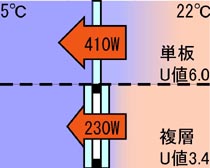
For FL3 (3mm glass)
(U-value) 6.0 W/㎡·K × (Glass size) 4 ㎡ × (Indoor-outdoor temperature difference) 17 °C
≒ 410 W
For FL3+Air Layer 6mm+FL3 Insulating Glass Unit
(U-value) 3.4 W/㎡·K × (Glass size) 4 ㎡ × (Indoor-outdoor temperature difference) 17 °C
≒ 230 W
Even the most basic insulating glass unit saves 180W of heat quantity per hour compared to 3mm single-pane glass.

Furthermore, in cold regions where outdoor air temperature becomes -10°C
(Calculation conditions Outdoor air temperature: -10°C, Indoor: 22°C, Window size: 2m × 2m)
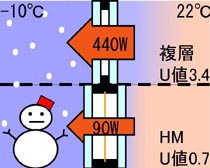
For FL3+Air Layer 6mm+FL3 Insulating Glass Unit
(U-value) 3.4 W/㎡·K × (Glass size) 4 ㎡ × (Indoor-outdoor temperature difference) 32 °C
≒ 440 W
For FL3+Insulating Gas 8mm+HM+Insulating Gas 8mm+LowE3
(U-value) 0.7W/㎡·K × (Glass size) 4 ㎡ × (Indoor-outdoor temperature difference) 32 °C
≒ 90 W
Even with insulating glass units, considerable heat quantity escapes outdoors, so need for glass with higher thermal insulation increases. The obtained values are heat quantities, so this is not directly about electrical consumption per hour decreasing by the above W numbers, but by reducing heat quantity escaping from indoors, indoor temperature can be maintained constant with less energy. Also, during summer cooling, while heat movement direction changes (heat moves from high-temperature side to low-temperature side), air conditioning costs can be reduced the same as in winter through thermal insulation improvement.