Glass Breakage Due to Impact
Due to material properties, glass breaks when subjected to strong force, but when breakage is caused by impact, it is roughly divided into two types of breakage patterns depending on collision object shape, material, and speed.
① Bending Failure
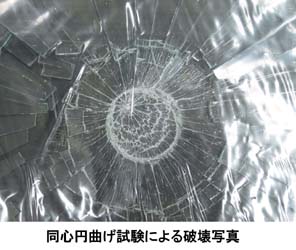
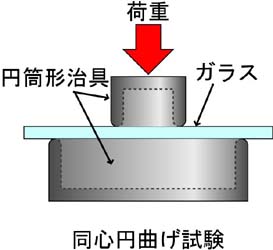
Bending failure is a phenomenon where glass deflects due to load received, and breakage occurs when deflection amount (internal stress generated) reaches the limit. When contact area with glass is large and collision speed is relatively slow during collision, it tends to become bending failure. Cases with causes like strong wind, human body, or soccer ball collision generally become this type of breakage. Also, for glass of about 3mm~5mm commonly used as household window glass, since rigidity is low and deflection is easily generated, in breakage tests with steel ball drop, it almost always becomes bending failure.
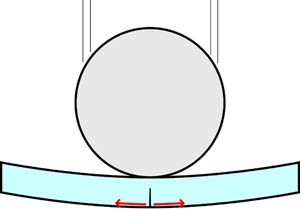
The entire glass deflects due to received impact, with compressive stress occurring on the deflection's inner side (impact surface) and tensile stress occurring on the deflection's outer side (back surface side). When deflection amount increases and back surface side tensile stress exceeds glass strength, glass breaks. Usually, cracks occur radially from the breakage starting point to edges, and the entire glass breaks. In thin laminated glass, only the back surface side glass may break.

② Hertz Failure
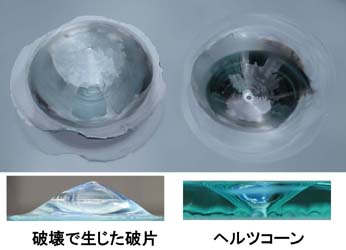
Hertz failure is a phenomenon that occurs when hard objects with small contact area collide with glass at high speed. Impact generated by collision propagates through glass interior as stress waves, and when these stress waves exceed glass strength, it becomes Hertz failure. In bending failure, breakage often occurs from impact point to glass edges, but in Hertz failure, local holes may form without overall breakage. Generally, holes generated by Hertz failure become conical shapes with holes becoming larger from impact surface toward back surface, called Hertz cones. Also, holes on back surface side generated by Hertz cones become smaller as collision speed increases. However, in reality, even if Hertz cones occur in glass, collision objects do not necessarily stop, so Hertz cones may be destroyed by remaining momentum, or overall breakage may occur with bending failure after Hertz failure.

Local deformation (indentation) occurs in glass due to received impact, and stress waves propagate roughly in directions orthogonal to this indentation surface. When this exceeds glass strength, conical breakage occurs.