
Glass (Windows) and Soundproofing 1 - Basic Knowledge
In explaining soundproofing performance of glass (windows), we first explain basic knowledge and terminology. For characteristics of single-pane glass, laminated glass, and insulating glass units, please refer to the article on " Glass (Windows) and Soundproofing 2".
・ Basic Knowledge About Sound
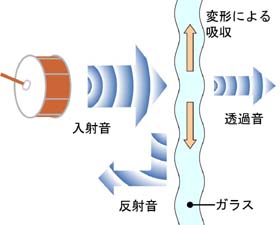
Sound transmitted through air is local air pressure fluctuations, where the amount of pressure change is sound magnitude (sound pressure), and the number of times pressure rises and falls per second is sound pitch (frequency). Sound incident on glass, like light, is divided into three: reflection, absorption, and transmission. In hard and heavy plate materials like glass, energy of incident sound mostly becomes reflected sound or transmitted sound, with almost no absorption effect. Therefore, when using glass with high soundproofing performance for musical instrument performance indoors, sound leakage to outdoors (transmitted sound) becomes small, but sound heard indoors (reflected sound) feels louder.
・ Mass Law
As mentioned above, sound transmitted through air is air pressure fluctuations, so sound does not directly transmit through airtight barriers like glass. Sound transmits through glass because pressure differences on both sides of glass caused by sound vibrate glass, and glass vibrates air on the opposite side from the sound source, transmitting sound. Expressing this phenomenon in mathematical formulas, the relationship (mass law) is obtained that soundproofing performance is proportional to the logarithm of frequency and surface density (mass per area) (when sound is incident perpendicularly, soundproofing performance increases by 6dB when glass weight or frequency doubles). From this formula, approximate soundproofing performance can be obtained.※1
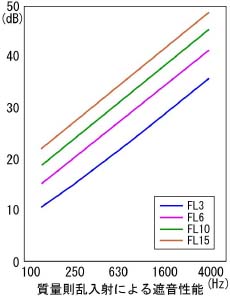
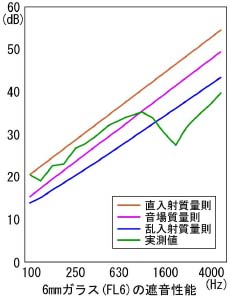

Actual soundproofing performance improvement when glass thickness is doubled is about 5dB, close to random incidence mass law, and double soundproofing performance is not obtained. Also, comparing a graph of soundproofing performance calculated by mass law for 6mm glass with actual measurement results, measured values differ from mass law, with soundproofing performance decreasing around 2000Hz. This is due to a phenomenon called coincidence effect.
・ Coincidence Effect
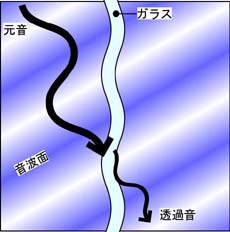
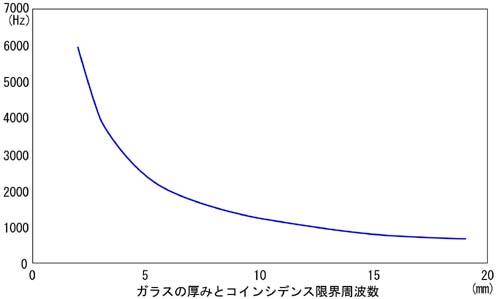
Mass law is a formula assuming barriers perform uniform piston motion, but hard and uniform planar structures like glass and concrete walls also develop bending vibration. When propagation speed of plane bending vibration and wavelength of sound waves obliquely incident on the plane match, vibration increases and soundproofing performance significantly decreases. This phenomenon is called coincidence effect. Graphing the lowest frequency (critical frequency) at which coincidence effect occurs in glass is as follows.※2 Each thickness of glass has coincidence effect at appropriate angles for sounds higher than this frequency, and soundproofing performance decreases compared to mass law calculation results. Since coincidence critical frequency changes with glass thickness (becomes lower as thickness increases), even if changed to thick glass for soundproofing purposes, if noise to be blocked is sound near the changed glass's coincidence critical frequency, thinner glass had higher soundproofing performance, which can also occur.
・ About Soundproofing Performance
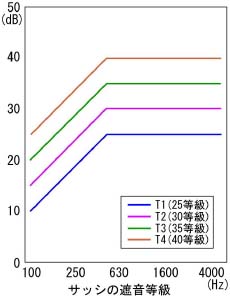
As indicators showing window soundproofing performance, the "JIS A4746 Sash" standard ※3 has four performance grades from T-1 to T-4, with T-1 requiring about 25dB and T-4 requiring about 40dB soundproofing performance, roughly divided every 5dB. However, even products displaying soundproofing performance T-2 do not have [-30db] soundproofing effects across all frequency ranges from low to high frequencies, and evaluation is in the 125~4000Hz range, and required performance decreases for frequencies below 500Hz. This is because performance standards were created considering realistic thickness following human hearing and mass law ※4, but depending on noise conditions and individual differences, it may differ from expectations. While higher grades mean higher soundproofing performance, to avoid failure, it is necessary to select something satisfactory by confirming not only grade but also noise causes and sound transmission loss values of products.