
Weight of Glass
Even when talking about glass weight, ordinary people probably don't have many opportunities to hold glass fitted in windows, but if imagining glass cups and tableware, etc., there is probably a general impression that it is heavy. For architectural glass, specific gravity (weight per unit volume) is about 2.5, so converted to weight, glass of 1m × 1m would be about 2.5kg per 1mm thickness. This is almost double that of general plastics (specific gravity 1~1.2), but compared to iron or stainless steel (specific gravity 7.8~8.0) it is 1/3, and even compared to aluminum (specific gravity 2.7~2.8), considered a lightweight metal, glass is slightly lighter.
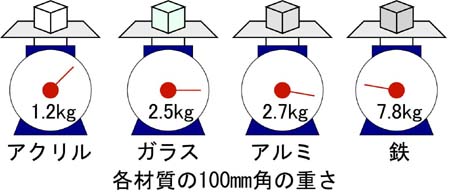
However, when asked "Which is heavier, aluminum or glass?", very few people can answer "aluminum is heavier." On the contrary, even when asked "Which is heavier, iron or glass?", answers like "glass is heavier" or "about the same" come back. Why is this, when few people make mistakes between iron and aluminum?
One cause of this misunderstanding is that when making products, even for the same use, structures differ according to material properties. Let's think about juice containers as a familiar example. First, thinking about plastic containers (PET bottles), PET bottles do not break with moderate force.
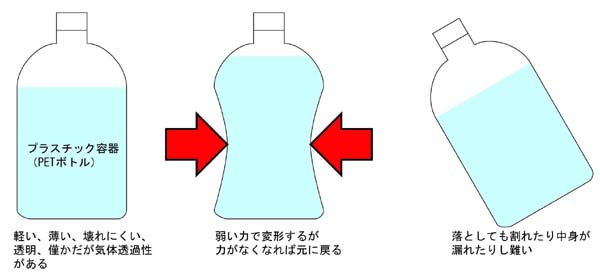
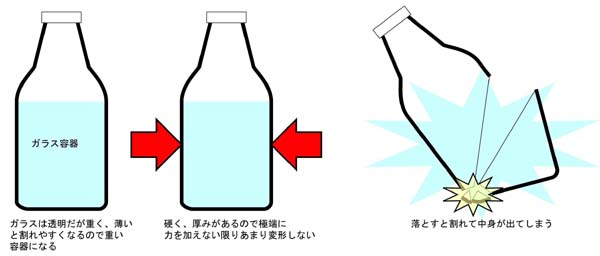
Compared to glass and metal, they deform under weak force, but except for very severe deformation, they return to original shape immediately when force is released. Therefore, thickness does not need to be very thick, and combined with light specific gravity, very light and practical containers can be made. Next, glass is hard and difficult to deform compared to plastic, but breaks when subjected to strong force. Since it cannot fulfill container role once broken, minimum strength (thickness) that can withstand daily handling is necessary. Then glass bottles become thicker than PET bottles and, combined with originally larger specific gravity, become heavy containers.
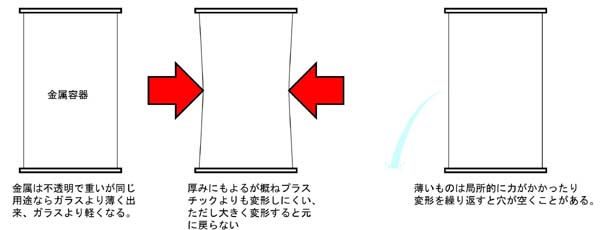
Iron has high strength and is difficult to deform, and normally does not break with usual handling. However, compared to plastic, it easily causes permanent deformation (does not return to original even when force during deformation is released), and develops cracks when deformation is repeated. Therefore, it cannot be made thin enough to deform just by holding, but can be made much thinner than glass, and despite specific gravity being heavier than glass, can be made lighter than glass containers.
This is not limited to containers; in windows (sash) or cars, metal parts generally use thin plates of 1mm or less formed into boxes or cylinders, or surfaces with irregularities, creating lightweight and high-strength structures, but glass, which is difficult to process such as bending and joining and has risk of breaking, is used as plates with some thickness and becomes heavy. In general households, I think there are almost no glass products with hollow structures (hollow inside) except for containers and thermal insulation purposes, or metal products of some size without hollows or cutouts. If there were opportunities to hold glass products and metal products made in the same shape, same thickness, and same structure, their weights would be values according to specific gravity numbers, resolving the misunderstanding, but then either easily breakable glass products or heavy and expensive metal products would result. In other words, glass is lighter than aluminum as a material, but when made into practical products, generally becomes heavier than not only aluminum but even iron. Therefore, since there are no opportunities to touch glass or metal as materials in daily life, product weight is misunderstood as material weight.