
Glass and Water
Glass (soda-lime glass) is used not only for windows but also for tableware and storage containers, giving an image of high strength and chemical stability, but it dissolves in water, the most familiar liquid. However, even though it dissolves, the main component of glass, silica (SiO2) itself does not dissolve in water, so of course it does not change shape before your eyes. However, extremely minute glass components (Na: sodium ions) dissolve from surfaces where water and glass are in contact. This component is common and contained in food, and has no impact on human bodies in terms of quantity or composition, and most building window glass and glass tableware and storage containers do not show visibly apparent effects. However, on glass surfaces, phenomena roughly as shown in the diagram below occur from water droplet attachment to drying, and in places like bathroom mirrors in high-humidity environments or automobile rear windows where rainwater is often left unattended, this erosion is repeated many times over long periods, resulting in "white clouding" that cannot be removed even by washing or "blue clouding" where reflected light appears rainbow-colored.
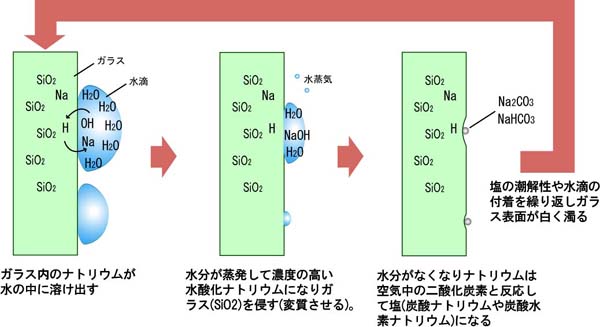
Glass Surface Erosion Phenomenon Due to Moisture Attachment
•Cleaning "Glass Clouding"
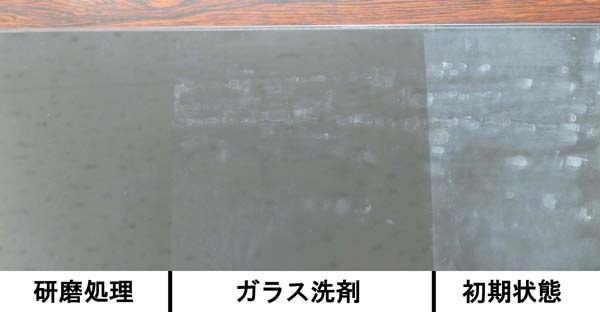
Cleaning results of glass stored in high-humidity environment (black spots are reflection images (reflections) of ceiling patterns)
The photo above divides glass placed in equipment set to 80°C temperature and 85% humidity for 2 weeks into three areas, comparing areas left as-is after removal, areas wiped with glass cleaner, and areas polished with polishing compound, photographed with glass placed on black paper to make white clouding easy to see.
The area left as-is after removal is dirty as if white paint had been dripped, but it was clean glass before equipment placement, just placed in a high-humidity environment. Next, the area wiped with glass cleaner and cloth in the middle has salt (alkali, product of chemical reaction, not table salt) attached to the surface removed and is somewhat clean, but glass clouding cannot be removed and remains white. Finally, the area with polishing treatment on the left edge has polished away the altered glass surface, making it clean.
White clouding-like dirt from detergent residue and water scale, or blue clouding-like dirt from oil attachment, etc., can be removed with thorough cleaning, but "glass clouding" requires removal of altered glass surface since the glass itself is also altered.*
•Prevention of "Glass Clouding"
Since glass clouding occurs due to moisture, it can be improved by not allowing moisture to attach to glass surfaces, or wiping immediately if attached, minimizing Na dissolution, or keeping in constant contact with large amounts of water, but this is not realistic depending on use and installation environment. It can also be improved with coatings, etc., but coating maintenance itself becomes necessary and is not perfect. In chemical experiments, since components dissolving from glass may interfere with experiments, and heat resistance against heating and heat generation is required, glass containers with different components from window glass (soda-lime glass), such as borosilicate glass and quartz glass, are used. Using such glass for windows would also improve clouding, but it becomes very expensive. Understanding that glass also weathers depending on environment, we recommend cleaning as much as possible within reasonable limits and washing away attached salt.