
Glass Operating Temperature
Among consultations from customers, we often receive inquiries like "Please tell us about glass that can be used for viewing windows of equipment that reaches ○○°C." For this reason, this time we explain regarding glass operating temperature.
•Single-Pane Glass (Soda-Lime Glass)
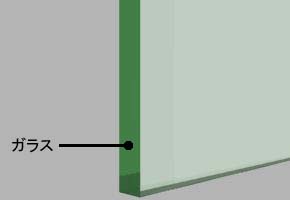
Glass, being almost uniform inorganic material, can originally withstand high temperatures of 400°C~500°C without burning or melting. However, when partial temperature differences occur in glass, " thermal breakage " occurs with temperature differences of only tens of degrees (thermal shock), causing breakage. Even if temperature changes are gradual in equipment, partial temperature differences occur in glass due to temperature differences between indoor and outdoor sides of glass, differences in heat dissipation between glass and fixing members causing temperature differences between periphery and center, temperature unevenness in equipment internal air, etc., and there is a risk of breakage. Using thick glass as a countermeasure against such thermal breakage makes temperature differences more likely to occur in glass, making breakage more likely. Also, in addition to breakage, high-temperature environments or high-humidity environments make glass clouding more likely, so there is a risk of gradual deterioration of transparency.
In low-temperature environments, glass clouding problems do not occur, but thermal breakage due to temperature differences (thermal shock) occurs the same as in high-temperature environments. When glass is heated or cooled overall, temperature changes occur sequentially from glass surface and periphery toward center, so the cooling process (center high temperature, surface low temperature → tensile stress occurs on surface) is more prone to breakage than the heating process (center low temperature, surface high temperature → compressive stress occurs on surface). Therefore, standard glass is not very suitable for use in extreme low or high temperature environments.

•Tempered Glass
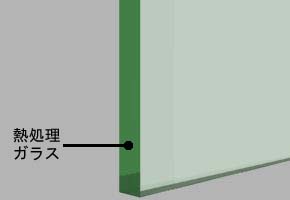
Tempered glass is glass with increased wind pressure resistance through heat treatment, and this strength also works effectively against thermal breakage. However, this effectiveness is only within the range of architectural use, and there is a risk of breakage when large temperature differences (thermal shock) exceeding 100°C occur. Also, tempering cannot reduce clouding problems. Furthermore, when exposed to high temperatures of 300°C or more, tempering stress applied to glass through tempering gradually decreases, and there is a risk of tempering effect reduction.
Problems in low-temperature environments are thermal breakage due to temperature differences (thermal shock), the same as standard glass. Therefore, tempered glass has slightly higher durability to low and high temperature environments than standard glass since it is less prone to thermal breakage, but there are limits as mentioned above, so caution is needed.
•Laminated Glass
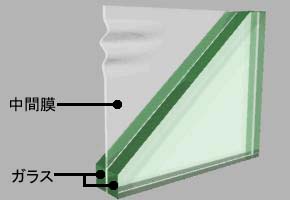
Laminated glass is glass bonding two panes of glass with special interlayer, and is glass that prevents glass fragments from scattering even when broken, reducing secondary damage. When glass temperature reaches 70°C or more, there is a risk of bubbles forming in the interlayer, so use in high-temperature environments is not suitable.
In low-temperature environments, depending on interlayer type, interlayer flexibility decreases with temperature decrease, and there is a risk that laminated glass's original performance cannot be demonstrated. Scattering and penetration performance evaluated in laminated glass JIS tests are for normal temperature (23°C) environments, but as part of quality control, adhesion evaluation in low-temperature environments is also performed.
•Insulating Glass Units
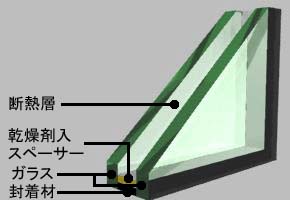
Insulating glass units are high thermal insulation glass with space between two panes of glass, fixed and sealed at periphery. When used in environments exceeding 70°C, deterioration of sealing materials used for surrounding sealing is promoted, and there is a risk of thermal insulation performance decrease or internal condensation in thermal insulation layer due to deterioration of fixing and sealing state. Also, there is a risk of glass deflection and breakage due to expansion of air sealed inside insulating glass units when heated, so use in equipment that becomes high temperature is not suitable.
In low-temperature environments, air sealed inside insulating glass units contracts, and there is a risk of glass deflection and breakage, breakage of sealing materials around air layers, or internal condensation in insulating glass units. In insulating glass unit JIS tests, dew point (highest temperature causing condensation on insulating glass unit inner surface) of -30°C or less is required after a total of 42 days of humidity and light resistance tests and 72 cycles of cold-heat repetition tests.※
As described above, use of architectural glass (soda-lime glass and its processed products) in locations where high temperatures are expected is quite limited. For such uses, please also consider use of borosilicate glass or quartz glass with small expansion coefficients (less prone to thermal breakage) and high chemical stability (less prone to clouding). Also, for pressure vessel viewing windows, soda-lime glass (tempered glass) can only be used at normal operating temperatures of 80°C or less and when contents are not corrosive (refer to JIS B8286). If glass is replaced with different glass than originally due to breakage replacement, etc., there is a risk of non-compliance with standards and inspections, which also relates to operator safety, so please select after consulting well with equipment manufacturers.
| ※ | In insulating glass unit JIS tests, dew point (highest temperature causing condensation on insulating glass unit inner surface) of -30°C or less is required after a total of 42 days of humidity and light resistance tests and 72 cycles of cold-heat repetition tests. This is performance guarantee assuming insulating glass units are used in environments of -30°C or higher, so please consult separately if use in environments below -30°C is planned. |