
Glass Blocks Ultraviolet Rays
Ultraviolet rays, blamed for sunburn, skin cancer, and furniture deterioration, are disliked for various reasons, but actually, even standard transparent glass hardly transmits the wavelength range (UV-B) harmful to human bodies. Similarly transparent glass, when made into Safer (Laminated Glass) , can block most ultraviolet rays.※
・ About Ultraviolet Rays
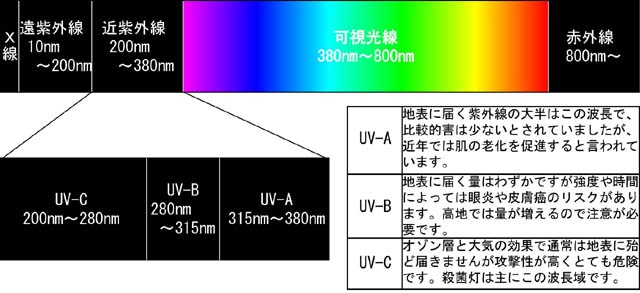
Ultraviolet rays are electromagnetic waves with wavelengths shorter than visible light (380nm~800nm) detectable by human eyes and longer than X-rays (10nm or less) used in X-ray photographs. Among these, ultraviolet rays with wavelengths of 200nm or less are absorbed by the atmosphere (nitrogen, oxygen, water vapor), so ultraviolet rays reaching the earth's surface as sunlight are in the range called near-ultraviolet (wavelength 380~200nm). This near-ultraviolet is further divided by impact on human bodies and environment into UV-A (400~315nm), UV-B (315nm~280nm), and UV-C (less than 280nm).
・ Glass Ultraviolet Transmittance
Ultraviolet transmittance of 3mm glass and 3mm+3mm laminated glass is as shown in the graph below. (Our company measurement values)
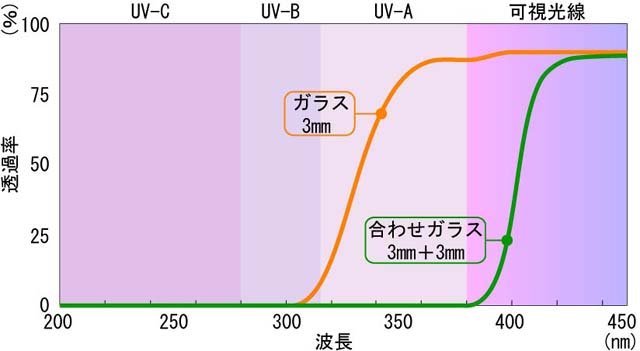
As shown in the graph, even standard 3mm glass has the effect of suppressing wavelengths below 300nm, most of harmful UV-B, to 1% or less, and Safer (laminated glass) with 3mm+3mm cuts 99% or more of ultraviolet rays including UV-A, i.e., wavelengths below 380nm. For those who spend long hours near windows or want to maintain beautiful skin, we recommend Safer (Laminated Glass) .