
Edge Processing
Glass cut edges are like sharp blades and are very dangerous to touch with bare hands. Also, for glass, pointed parts easily become starting points for breakage, and it becomes difficult to maintain consistent strength and appearance quality near edges as-is. Therefore, many glass pieces we ship have processed cut surfaces, but different finishes are required for cases where edges are hidden when fitted into sash versus cases like table tops where edges are exposed. Such edge surface processing is called edge processing, and there are several types of processing shapes and surface finishes, so we introduce them.
(Each processing name is our company's terminology and not a general name.)
Types of Processing Shapes
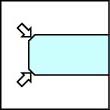
・Edge Chamfering
Processing that grinds cut surface corners by about 1mm, mainly performed to prevent injury and glass chipping. This is the most basic edge processing. Usually, minimum necessary when performing lamination or tempering processing.

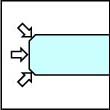
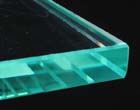
・Flat Polishing
Processing that grinds both cut surface corners (above edge chamfering) and edge surfaces (edges), finishing edge surfaces flat. Mainly used for glass-to-glass abutting surfaces and exposed-edge glass doors, display cases, etc.
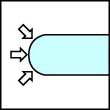
・Rounded Edge
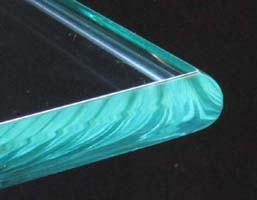
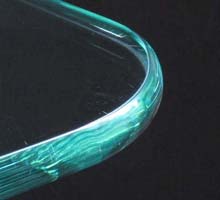
Processing that grinds edges round so that cut surfaces viewed from the side become rounded edge shape. Since there are no corners between surfaces and edges, when finished with premium polishing, it becomes smooth to the touch. Used for high-end glass table tops, etc. When using entire glass exposed, corner radius processing is recommended.
・Beveled Edge
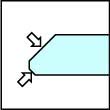
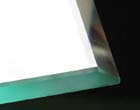
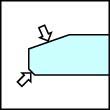
Processing that polishes cut surfaces (edges) diagonally, performs edge chamfering on opposite tip parts, and finishes edge surfaces diagonally. Mainly used for decorative purposes and angled abutting surfaces such as display case corners.
・Wide Chamfer
Processing that makes beveled edge slope shallower, allows wider chamfer width, and can also adjust thickness left on edge surfaces (edges). Mainly used for decorative purposes, giving glass a luxurious feel. Also used for mirror decoration.
Types of Surface Finishes
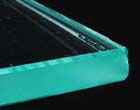
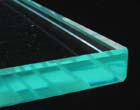
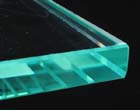
Flat polishing, rounded edge, beveled edge, and wide chamfer other than edge chamfering can have three levels of surface finishes according to glass use. We introduce their differences using flat polishing as an example.
・Rough Grinding (Matte Finish)
State after grinding to shape edges. Surface is rough and whitish, with low transparency finish. Mainly used for abutting surfaces, etc., where shape processing is the main purpose.
・Polishing
Finished with polisher after rough grinding. No gloss but whitishness is removed, and transparency appears. Used for decorative abutting surfaces like display cases and exposed-edge glass doors.
・Premium Polishing (Mirror Finish)
Finished by further polishing with felt after polishing. Has gloss like the surface. Edge surfaces shine with reflected light, making this the finish that best brings out the luxury of edge processing.
Edge chamfering, which only aims to remove corners, can also be done by hand with a grinder, but other processing is performed by machine since appearance and precision are important. To finish hard glass smoothly, base treatment of grinding with diamond grinding wheels while applying water and finish polishing using polishing compounds must be performed accurately.