
LowE Glass
What is LowE Glass
LowE in LowE glass is an abbreviation for "Low Emissivity" (low emissivity), and refers to glass coated with low-emissivity metal on its surface. Heat transfer by radiation (electromagnetic waves) refers to heat transfer by infrared rays (near-infrared, far-infrared), which occurs between all objects. Near-infrared rays have wavelengths close to visible light and pass through many objects including glass, but far-infrared rays have no transmittance through many solids and liquids such as glass, plastic, and water, and are absorbed at the surface. The absorbed infrared rays turn into heat and are radiated again from the warmed glass surface. LowE glass has the effect of significantly reducing this radiation, suppressing heat transfer by radiation between glass panes separated by an air layer by about 80%. Also, since the low emissivity of far-infrared rays is due to high reflectivity, the orientation of LowE insulating glass units has almost no effect on thermal insulation performance.
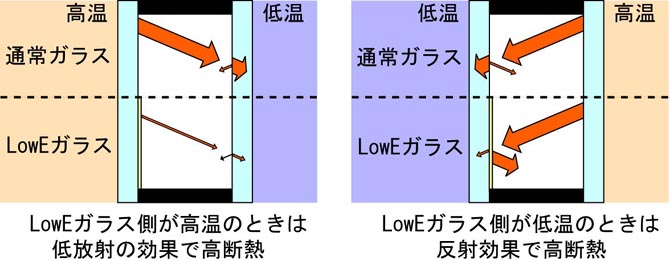
Classification of LowE Glass by Manufacturing Method
LowE glass has two types, soft and hard, depending on the difference in manufacturing method. Hard LowE glass is glass manufactured by spraying onto high-temperature glass immediately after it emerges from the melting furnace during glass manufacturing. It is very stable, and even when used as a single pane, the coating hardly changes or deteriorates. (However, the coating has fine irregularities, making it prone to dirt that is difficult to remove, so single-pane use is not recommended.) Soft LowE glass is regular glass that has been subjected to sputtering treatment, etc. Unlike hard LowE, soft LowE oxidizes and discolors when left in general atmosphere, and LowE performance decreases, so it must be sealed inside an insulating glass unit. Solar shading performance and color tone vary depending on the type of coating.