How to Identify Air-Cooled Tempered Glass
Tempering is processing that increases glass strength and makes glass resistant to breakage. The effect is surprisingly large, and even 5mm thick glass becomes difficult to break with bare hands when tempered. Also, even if it breaks, the entire glass breaks into granular pieces, reducing secondary damage from glass fragments. While tempering compensates for glass's weakness of breaking to some extent, appearance hardly changes even after processing. This time, we explain methods to identify tempered glass and non-tempered glass.
Breakage
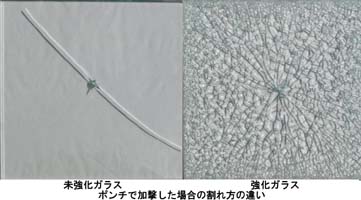
JIS specifies that when tempered glass is broken, the number of fragments within a 50mm × 50mm square area must be 40 or more, and factories occasionally process breakage samples together with products for confirmation. While the simplest and most certain identification method, since objects become shattered, the glass itself that you want to use cannot be identified.

Distortion
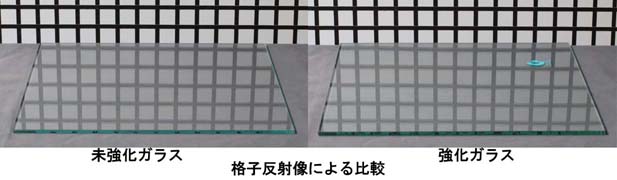
Air-cooled tempered glass manufactured by heating glass to about 700°C and rapidly cooling with strong wind develops distortion due to temperature unevenness during rapid cooling. While not particularly noticeable in normal use, distortion becomes easily visible when viewing scenery through glass at shallow angles, when moving gaze while staring at a single point of scenery through glass, or when viewing reflected images in glass. Non-tempered glass has almost no distortion, but installed glass may have distortion depending on installation conditions. Also, tempered glass distortion has individual differences, and some are almost indistinguishable, so certain identification is difficult.
Measurement with Stress Meter
There is a tool called a stress meter that measures tempering stress of tempered glass. JIS R3222 (heat-strengthened glass) specifies ranges of tempering stress, and this is necessary when receiving JIS certification for heat-strengthened glass. Since results are shown as numbers, identification of non-tempered, heat-strengthened, and tempered glass is possible. However, measurement can only be performed on the tin side (bottom surface) of glass made by the float method, so prior glass surface identification is necessary.
Identification with Polarizing Plates
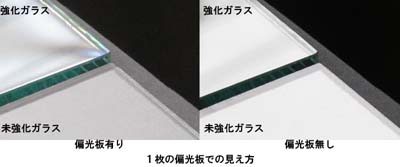
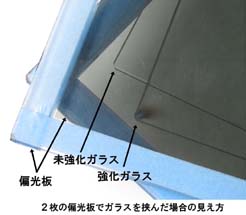
When tempered glass is sandwiched between two polarizing plates and the crossing angle of polarizing plates is adjusted, distortion from tempering stress can be seen near glass vertices and edges. Since it is simple and results are easy to understand, this method is used when identification is necessary within factories. If only one polarizing plate is available, glass can be placed facing an LCD screen and polarizing plate angle adjusted to similarly confirm. (This is because LCD screens use polarizing films.) Also, reflected light from shallow angles viewing glass obliquely has a high proportion of polarized light, so this can also be confirmed with a single polarizing plate, but it is difficult unless in a bright place like under sunlight.