
Low-Reflection Glass and Non-Glare Glass
In addition to high transparency, glass also has beautiful gloss as a visual characteristic. Gloss is an important element affecting impressions of glass such as cleanliness and luxury, but when used as cover glass for picture frames and display cases, gloss can make glass shine, making contents difficult to see. There are two types of glass suitable for such uses: non-glare glass and low-reflection glass, so we explain their differences.
Non-Glare Glass (Anti-Glare Glass)
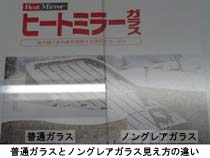
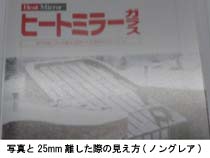
Non-glare glass is glass with fine irregularities on both front and back surfaces that makes reflection difficult to see by diffusing reflected light. Due to diffusion, reflected light is somewhat averaged, so local glare is reduced, but overall reflectance itself is unchanged from standard glass. Also, the diffusion effect from irregularities diffuses not only reflected light but also transmitted light. Therefore, unless used in applications like picture frames where objects are almost in contact, it becomes blurred and objects become difficult to see.
Low-Reflection Glass (AR Coated Glass)
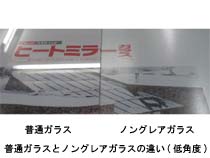
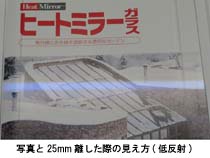
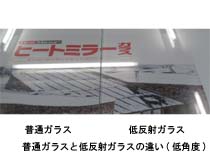
Low-reflection glass is glass with coatings on both front and back surfaces that reduce light reflection, reducing reflectance to about 1% (standard glass has reflectance of about 8%). Unlike non-glare glass, the surface is smooth, so objects can be seen without blurring even when distance is increased. However, depending on coating type, reduced reflected images may appear bluish-purple, or sufficient effects may not be obtained with shallow-angle reflections viewing the surface from the side. Since coatings are applied to both sides, careful handling and maintenance are required, it is basically for indoor use only, it is very expensive, and sufficient consideration is needed for introduction.

*Currently, glass handled by our company is mainly for architectural use.
We are very sorry, but we cannot handle consultations for smartphones or special low-reflection glass or non-glare glass.