
Considerations for Floor Glass
When Skywalk, a glass-covered walkway, was installed at the Grand Canyon, glass floors became a topic of discussion, but when observing floor glass displayed at glass industry exhibitions, many people avoid walking on the glass. This may be consideration to avoid damaging display products, but even when actually installed in buildings, few people walk confidently on glass installed at heights. Here, to provide some peace of mind, we explain the floor glass selection process we perform.
1. Load Value Settings According to Glass Size
As individual glass pieces become larger, more people can ride on each piece, and larger loads are expected. Therefore, in strength considerations for floor glass, loads are set according to glass size and strength considerations are performed. Also, loads generated just by walking are several times body weight, so this point is also considered in the evaluation. This means that except for very small items, most floor glass requires strengthening treatment.
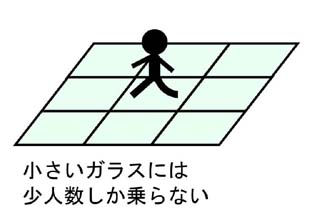
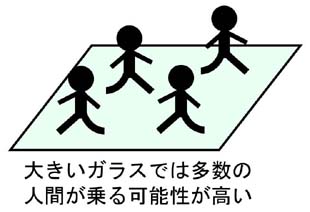
2. Laminated Glass Structure to Prevent Fall Even if Broken
No matter how thick glass with excellent load resistance is used, it may break when strong impact is applied with hard objects, etc. Even in such cases, if it is laminated glass, glass other than the surface remains unbroken, so fall prevention is highly possible. Therefore, strength considerations for floor glass use laminated glass compositions where remaining glass can withstand assumed loads even if surface glass breaks.
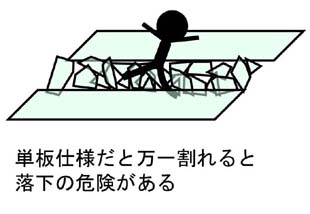
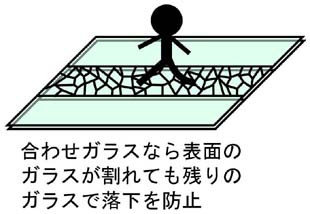
3. Deflection Considerations
No matter how sufficient in strength, if it deflects greatly with each step, it is very difficult to walk with peace of mind. To prevent this, considerations are made so that laminated glass deflection is below a certain value for assumed loads. Note that to reduce deflection, only increasing the thickness of constituent glass or making glass smaller is possible. Strengthening treatment only increases strength and does not affect deflection.
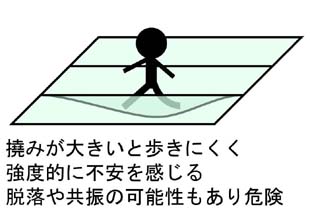
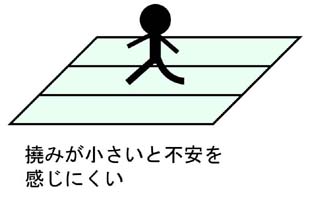
When using glass for floors, these three points are considered to determine necessary glass composition. Therefore, floor glass with no broken panes has strength margin beyond the first consideration due to the second fall prevention measure, and can be said to be strong. However, no matter how much safety is ensured and this is understood intellectually, it may be natural to avoid it just for being a "transparent floor at height." If Glass Spider were used as floor material, even with explanations, probably almost no one would walk on it, but there have been no adoption cases so far.