
Multi-Layering of Insulating Glass Units
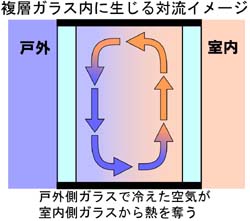
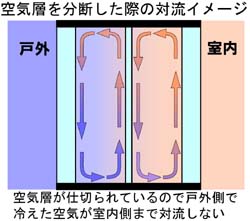
Standard insulating glass units have a structure with an air layer between two panes of glass, and thermal insulation improves by increasing air layer thickness. However, this method does not mean that performance increases the more thickness is increased; when air layer thickness exceeds a certain level, further thermal insulation improvement cannot be expected. This is due to convection occurring inside insulating glass units, and even if thickness is increased beyond a certain point, thermal insulation hardly changes because convection (air flow) carries heat. In such cases, higher thermal insulation can be obtained by dividing the air layer so that air does not convect to the opposite side, and adjusting each air layer to an appropriate thickness. In the case of standard insulating glass units, this means dividing with glass, but then total thickness must be increased by the thickness of newly added glass, or air layers must be reduced. Also, increasing glass increases weight, so when used in sash, etc., movement becomes heavier. Heat Mirror Glass is glass suitable for such cases. Heat mirror glass divides air layers with thin film, so air layers can be divided without sacrificing weight or thickness.
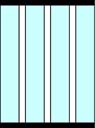
Dividing air layers with glass reduces air layers by glass thickness, preventing expected thermal insulation performance. Weight also increases significantly.
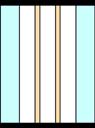
Heat mirror film is thin (about 0.1mm), so even with multi-layering, air layers hardly decrease and weight increase is minimal.
| Composition | Total Insulating Glass Unit Thickness (Air Layer Thickness) | |||||
| 12mm (6mm) | 15mm (9mm) | 18mm (12mm) | 22mm (16mm) | 25mm (19mm) | 31mm (25mm) | |
| FL3+Air Layer+FL3 | 3.3 | 3.1 | 2.9 | 2.8 | 2.8 | 2.8 |
| FL3+Air Layer+LowE3 | 2.5 | 2.0 | 1.7 | 1.6 | 1.5 | 1.5 |
| FL3+Air Layer+TC88+Air Layer+FL3 | - | - | 1.7 | 1.4 | 1.2 | 1.0 |
FL: Standard glass, LowE: Low-emissivity glass, TC88: Heat mirror film, Numbers: Thickness (mm)
(Calculation conditions Outdoor: 0°C Indoor: 20°C Unit: W/m²·K)
As shown in the table, when air layers of 16mm or more can be created, very high thermal insulation effects can be expected due to heat mirror effects. On the other hand, when air layers are 12mm or less, since convection effects are originally small, the effect of division is small, similar to compositions using LowE glass. However, this does not necessarily mean that heat mirror glass has no benefits in insulating glass units with air layers of 12mm or less. When insulating gases such as argon gas, krypton gas, or xenon gas are used in air layers, division effects can be confirmed even with 12mm air layers.
For energy-saving renovation of the Empire State Building in America, ultra-high thermal insulation Heat Mirror Glass using heat mirror film and filled with xenon gas in air layers has been adopted.
Southwall Technologies – News Release(2010/04)
| Insulating Layer Thickness | Composition | Air | Argon | Krypton |
| 12mm | FL3+G12+FL3 | 2.9 | 2.7 | 2.6 |
| FL3+G12+LowE3 | 1.7 | 1.4 | 1.2 | |
| FL3+G6+TC88+G6+FL3 | 1.7 | 1.3 | 0.9 | |
| 19mm | FL3+G19+FL3 | 2.8 | 2.7 | 2.6 |
| FL3+G19+LowE3 | 1.6 | 1.3 | 1.3 | |
| FL3+G9.5+TC88+G9.5+FL3 | 1.2 | 1.0 | 0.7 | |
| FL3+G6+TC88+G6+TC88+G6+FL3 | 1.2 | 0.9 | 0.6 | |
| 25mm | FL3+G25+FL3 | 2.8 | 2.7 | 2.6 |
| FL3+G25+LowE3 | 1.6 | 1.4 | 1.3 | |
| FL3+G12.7+TC88+G12.7+FL3 | 1.0 | 0.8 | 0.7 | |
| FL3+G8+TC88+G8+TC88+G8+FL3 | 1.0 | 0.8 | 0.5 |
FL: Standard glass LowE: LowE glass TC88: Heat mirror film G: Air layer Numbers: Thickness (mm)
(Calculation conditions Outdoor: 0°C Indoor: 20°C Unit: W/m²·K)