
Thermal Breakage Phenomenon

When hot water is poured into a glass cup that is not heat-resistant glass, it may break. This is because at the moment hot water hits, the hit part (surface) instantly becomes high temperature and expands, while the surrounding areas and back surface of the glass that were not directly hit by hot water take time for temperature to transfer, so at the moment hot water hits, the glass surface becomes non-uniform with the high-temperature part trying to expand while the surrounding low-temperature parts remain in normal state without temperature rise or expansion. In this state, the low-temperature parts constrain the high-temperature part trying to expand, generating force (stress) that pushes and spreads the low-temperature parts (glass periphery). This force becomes stronger as the temperature difference between low-temperature and high-temperature parts increases, and when it exceeds the glass's allowable stress, breakage occurs.

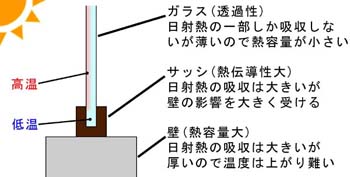
Window glass also has the same risk of breakage due to such temperature differences. When window glass receives direct sunlight, it absorbs part of that energy and its temperature rises. However, the glass periphery is in a state where it does not receive direct sunlight inside the sash, and also affected by heat dissipation from sash and building structure, temperature differences occur between the periphery (low temperature) and center (high temperature). Breakage of window glass due to this temperature difference is called thermal breakage. On clear winter mornings, conditions become severe with "strong sunlight," "low sash/building structure temperature," and "indoor-outdoor temperature difference," making thermal breakage more likely. Thermal breakage can also occur more easily depending on glass installation environment, so we explain such conditions.
Points to Note When Considering Glass Thermal Breakage
| • Heat-absorbing / Heat-reflecting glass | These high-absorption glass types have glass temperature rise easily from direct sunlight, making thermal breakage more likely than transparent glass. |
| • Seals and solar shading film | When seals or solar shading film are applied, the absorption rate of the applied part increases, glass temperature rises easily, and thermal breakage becomes more likely. |
| • Wired glass, wire glass | Metal in wired glass and wire glass rises in temperature more easily than glass, and thermal expansion coefficient differs from glass, making thermal breakage more likely. |
| • Thick glass | Making glass thicker is effective against external forces such as wind and gravity. However, regarding thermal breakage, increasing thickness increases solar heat absorption rate and makes temperature rise easier, so thermal breakage becomes more likely. |
| • Curtains and blinds | When curtains or blinds are near glass, heat absorbed by glass increases due to reflection from curtains and blinds, and heat accumulates between glass and curtains, making glass temperature rise easier and thermal breakage more likely. |
| • Heating/cooling equipment | When installed so that air from heating/cooling equipment directly hits glass, temperature differences between indoor and outdoor sides of glass become larger easily, and temperature becomes non-uniform within the surface, making thermal breakage more likely. |
| • Shadows from trees and utility poles | When shadows fall on the glass surface, temperature distribution becomes non-uniform, making thermal breakage more likely compared to when there are no shadows. |
| • Glass edge quality | If there are cracks or chips on glass edges, they become factors for significant strength reduction, and thermal breakage can occur easily even with slight temperature differences. |
| • Glass size | Even if the temperature difference within glass is the same, as size increases, the expansion amount as dimensions becomes larger, and generated stress becomes larger, so larger sizes make thermal breakage more likely. |
| • Sash color | Light colors absorb less heat compared to dark colors that easily absorb heat, so sash temperature does not rise easily, making thermal breakage more likely. |
| • Glass fixing method | The impact of glass fixing method to sash on thermal breakage cannot be definitively stated as it varies depending on temperature conditions of sash and glass, but for consideration, higher thermal insulation from sash is considered better. |