
Deformation of Insulating Glass Units Due to Environmental Changes
Due to the structure of insulating glass units that seal air inside, when the manufacturing environment differs from the usage environment, the internal air expands and contracts, causing deflection in the glass. This time, we explain deformation due to these environmental changes.
Deflection Due to Temperature Changes
Compared to solids such as glass and spacers that make up insulating glass units, air (gas) has very large volume changes with temperature changes, expanding when temperature increases and contracting when temperature decreases. Since insulating glass units have a structure that seals air inside, when the internal air changes volume, deflection occurs in the glass. This causes the glass to deflect outward when temperature is higher than during manufacturing due to internal air expansion, and deflect inward when temperature is lower than during manufacturing due to air contraction.

Same Temperature as During Manufacturing
If the temperature is the same as during manufacturing, the air inside the insulating glass unit has the same volume as when sealed, so it is in a standard state with no expansion or contraction of the insulating glass unit.

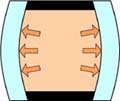
Higher Temperature than During Manufacturing
When the temperature (= temperature of sealed air) becomes higher than during manufacturing, the volume of air sealed inside the insulating glass unit expands, and the insulating glass unit becomes in an expanded state.
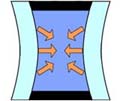
Lower Temperature than During Manufacturing
When the temperature becomes lower than during manufacturing, the volume of air sealed inside the insulating glass unit contracts, and the insulating glass unit becomes in a concave state.
Deflection Due to Altitude (Pressure Changes)
In addition to temperature changes, when the atmospheric pressure around the insulating glass unit differs from the pressure during manufacturing, the insulating glass unit deforms due to the balance of internal and external pressures. The internal air of insulating glass units is sealed at approximately 1 atmosphere, so when taken to high altitudes with low pressure, it expands, and when taken to underground areas with high pressure, etc., it contracts.
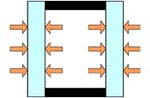
Plains (Altitude Close to Manufacturing)
In general areas such as plains or small hills, the balance between the pressure of sealed internal air and the atmospheric pressure around the insulating glass unit is maintained, resulting in a standard state with no expansion or contraction.
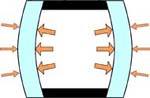
High Altitude (Places Exceeding 500m Altitude)
At high altitudes, since the surrounding atmospheric pressure is lower than the pressure of air sealed inside the insulating glass unit, the internal air layer expands and the insulating glass unit bulges.
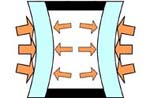
Underground (Hundreds of Meters) or Underwater
Underground or underwater, since the surrounding atmospheric pressure (pressure) is higher than the pressure inside the insulating glass unit, the air layer of the insulating glass unit is compressed and the insulating glass unit becomes in a concave state.
In this way, due to the structure of insulating glass units that seal air inside, deformation occurs in environments significantly different from manufacturing, and there is a risk of glass breakage. If the structure does not seal the air layer, air can enter and exit to prevent deformation, but thermal insulation performance decreases, and the dry state of internal air cannot be maintained, resulting in condensation inside the insulating glass unit. Therefore, when installing insulating glass units at high altitudes, or when transportation requiring air transport or passage through high altitudes is necessary, sufficient consideration must be given, and special measures may be required depending on the case. Please consult with us in advance if such situations are anticipated.