
Glass Defects and Terminology
Like other industrial products, glass has defects that occur during the manufacturing process. We introduce the types of these defects and their terminology in the glass industry.
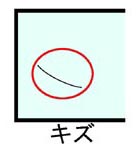
Scratch
Generally, glass is a material resistant to scratches, but it is not completely scratch-proof. Scratches detectable by finger can gradually grow into cracks when force is repeatedly applied, and may cause breakage, so caution is needed.

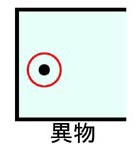
Foreign Matter
Glass is manufactured by crushing and mixing raw materials such as stone, then melting them. Impurities that could not be removed at the crushing stage, or raw materials that did not fully melt during the melting process, may be found inside the glass as foreign matter.
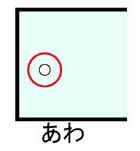
Bubble
Bubbles that formed inside glass in a molten state at high temperature during manufacturing remain in the glass after cooling.
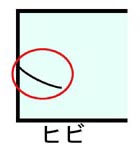
Crack
Cracks occur when strong force or impact is applied during glass handling. Once a crack forms, force applied to the glass concentrates at the crack tip due to partial temperature differences in the glass or wind, so even without touching, cracks gradually grow and the possibility of breakage becomes very high.
Defects Occurring on Edges
The most basic cutting method for glass is to score the surface with a glass cutter (creating a scratch), then break along that line. This method requires skill in both handling the glass cutter and breaking, and experience is needed to cut without defects. There are also processing methods such as water jet cutting with abrasive particles in water, or grinding with rotating grinding wheels, but these require large-scale equipment and take more time than cutter-based cutting, so they are mainly used only for shapes that are difficult to break.
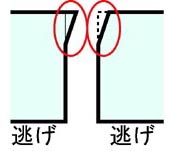
Edge Deviation
A state where the cut edge deviates from the glass cutter line during glass breaking. Usually occurs on the side opposite to the breaking starting point.
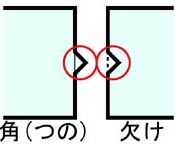
Horn, Chip
A state where part of the glass deviates from the cutter line during glass cutting. The convex deviated part is called a horn, and the concave deviated part is called a chip. Chips can also occur when hard objects hit the edge, not just during cutting.
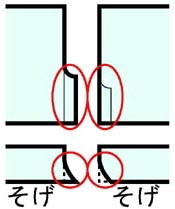
Chipping
A state where the cut edge does not break straight in the thickness direction during glass cutting. The protruding part has a very sharp tip and is very dangerous. Because it is very sharp, it is also brittle, so if the edge is rubbed with a hard object, it will chip off in pieces.
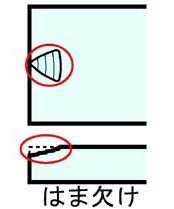
Shell Chip
A state where the surface chips in a shell-like pattern from the edge as the base point when strong force is applied to the glass edge. If the depth is shallow, it is not much of a strength problem.
Defects in glass alone are generally classified as above. Processed glass such as laminated glass and insulating glass units may have other defects.