
Gas Concentration in Gas-Filled Insulating Glass Units
Gas Injection Method
In the gas injection process for insulating glass units, insulating glass units with holes in the top and bottom spacers are generally stood upright, and gas is injected from the lower hole while air inside the insulating glass unit is removed from the upper hole. This method allows injection of insulating gas, which is heavier than air, with simple equipment, so it is commonly performed by our company and others as a manufacturing method for gas-filled insulating glass units.
Gas Concentration and Thermal Insulation Performance
With the above manufacturing method, as gas concentration inside the insulating glass unit increases, efficiently expelling only air becomes difficult, making it difficult to achieve 100% gas concentration inside the insulating glass unit. Values measured by attaching a gas concentration sensor to the exhaust line and measuring injection amount and gas concentration are as shown in the graph below.
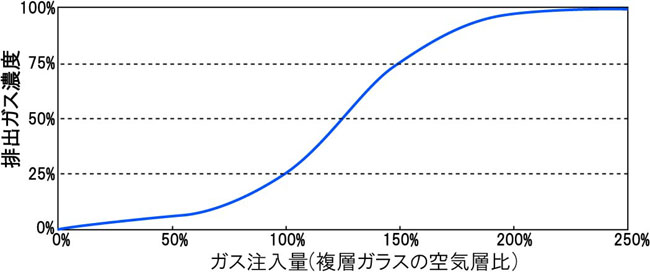
It can be seen that increasing gas injection amount can reach values quite close to 100%, but it can also be seen that injection losses gradually increase from around when gas concentration exceeds 90%. In contrast, thermal insulation performance relative to gas concentration changes linearly as shown in the graph below, so cost-effectiveness worsens as gas concentration approaches 100%. (Increase in injection amount also increases work time, compounding cost increases)
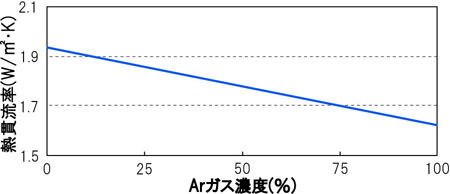
Based on these factors, our company manufactures with injection amounts targeting gas concentration exceeding 90% in the exhaust line, considering the balance between cost and performance, and also performs performance value simulations at 90% gas concentration.
(Generally, gas concentration inside insulating glass units becomes higher than exhaust line gas concentration.)