Float Glass Front and Back
Almost all smooth glass used as architectural glass today is manufactured using the float method. The float method is a manufacturing process that creates flat sheets by floating molten glass on molten tin, producing glass with very little distortion. While usually not noticeable, the surface of glass made by this method that was in contact with tin has a thin layer of tin attached. This surface is called the bottom surface (tin side), and the opposite surface that was not in contact with anything is called the top surface (non-tin side). While this has no impact on daily use, in printing processes, the tin can cause slight color differences between front and back, and in lamination processes, the interlayer adhesion strength can vary, so identification may be necessary depending on the processing content.
Methods to Identify Front and Back
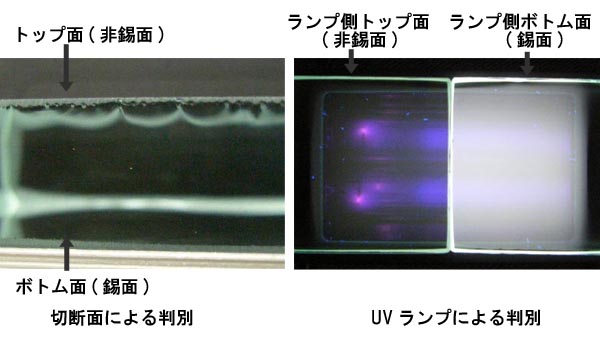
Identification by Cut Edge
Glass manufactured by the float method flows through the production line without being flipped after cooling and solidifying, and is cut in the cutting process. In the cutting process, the glass is supported from below while a cutter runs along the upper side (top surface) of the glass, and the glass is broken along this scratch, producing square-cut pieces that are shipped. Processing companies like ours cut these to product size, but even during this cutting, the cutter is applied from the top surface (non-tin side) as in the initial process. If glass is cut with the cutter applied to a unified surface, the front and back can be determined by identifying the cutter surface from the cut edge. However, this method cannot be used if cutting was done without considering the surface, or if the cut edge has been polished.
UV Lamp Inspection Method
When ultraviolet light is irradiated onto float glass using a fluorescent inspection lamp, nothing particular happens on the top surface (non-tin side), but the bottom surface (tin side) glows white. This is because glass has difficulty transmitting ultraviolet light below 300nm, so when ultraviolet light is irradiated onto the bottom surface (tin side), the tin on the surface fluoresces, whereas when irradiated onto the top surface (non-tin side), it is absorbed by the glass and does not reach the tin. This difference is visually or mechanically confirmed for identification.